×
Request Free Sample ×

Kindly complete the form below to receive a free sample of this Report

Leading companies partner with us for data-driven Insights

clients tt-cursor
Hero Background

Search And Rescue Drone Market

ID: MRFR/ICT/23212-HCR
100 Pages
Aarti Dhapte
October 2025

Search And Rescue Drone Market Research Report: By Drone Type (Fixed-Wing Drones, Multi-Rotor Drones, Hybrid Drones), By Payload Capability (Small Payload (up to 2 kg), Medium Payload (2-10 kg), Large Payload (10 kg and above)), By Application (Search and Rescue, Disaster Response, Environmental Monitoring, Surveillance), By Autonomy Level (Manual Control, Semi-Autonomous, Fully Autonomous), By Flight Endurance (Less than 30 minutes, 30 minutes to 1 hour, 1 hour to 3 hours, More than 3 hours) and By Regional (North America, Europe, South Ame... read more

Share:
Download PDF ×

We do not share your information with anyone. However, we may send you emails based on your report interest from time to time. You may contact us at any time to opt-out.

Search And Rescue Drone Market Infographic
Purchase Options

Search And Rescue Drone Market Summary

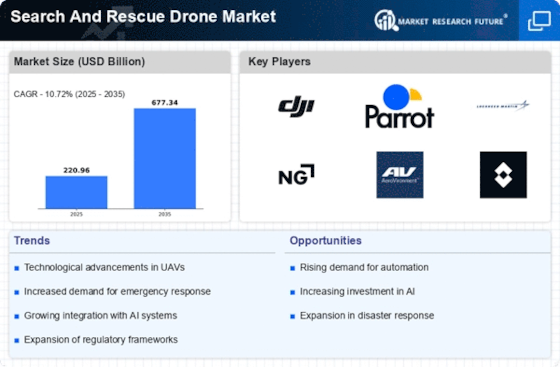
As per MRFR analysis, the Search And Rescue Drone Market Size was estimated at 220.96 USD Billion in 2024. The Search And Rescue Drone industry is projected to grow from 244.64 USD Billion in 2025 to 677.34 USD Billion by 2035, exhibiting a compound annual growth rate (CAGR) of 10.72 during the forecast period 2025 - 2035.

Key Market Trends & Highlights

The Search and Rescue Drone Market is poised for substantial growth driven by technological advancements and increasing demand for emergency response solutions.

  • North America remains the largest market for search and rescue drones, driven by robust investment in public safety technologies.
  • The Asia-Pacific region is emerging as the fastest-growing market, reflecting a rising need for efficient emergency response capabilities.
  • Multi-rotor drones dominate the market due to their versatility, while small payload drones are experiencing the fastest growth in demand.
  • Technological advancements in drone capabilities and regulatory support are key drivers propelling market expansion.

Market Size & Forecast

2024 Market Size 220.96 (USD Billion)
2035 Market Size 677.34 (USD Billion)
CAGR (2025 - 2035) 10.72%

Major Players

DJI (CN), Parrot (FR), Lockheed Martin (US), Northrop Grumman (US), AeroVironment (US), FLIR Systems (US), senseFly (CH), Skyfish (US), Quantum Systems (DE)

Search And Rescue Drone Market Trends

The Search And Rescue Drone Market is currently experiencing a notable evolution, driven by advancements in technology and increasing demand for efficient emergency response solutions. Drones are being integrated into various rescue operations, enhancing the capabilities of search teams. These aerial devices offer real-time data transmission, high-resolution imaging, and the ability to access hard-to-reach areas, which significantly improves the chances of locating missing persons or assessing disaster-stricken regions. As public safety agencies and private organizations recognize the potential of drones, investment in this sector is likely to grow, fostering innovation and expanding applications. Moreover, the regulatory landscape surrounding drone usage is gradually becoming more defined, which may facilitate broader adoption across different regions. Governments are establishing guidelines to ensure safe operation while promoting the use of drones in search and rescue missions. This regulatory clarity could encourage more stakeholders to enter the market, potentially leading to increased competition and further advancements in drone technology. As the Search And Rescue Drone Market continues to mature, it appears poised to play a crucial role in enhancing emergency response capabilities worldwide, ultimately saving lives and improving outcomes in critical situations.

Technological Advancements

The Search And Rescue Drone Market is witnessing rapid technological progress, with innovations in artificial intelligence, machine learning, and sensor technology. These advancements enhance the operational efficiency of drones, enabling them to perform complex tasks autonomously and gather critical data in real-time.

Regulatory Developments

The evolving regulatory framework surrounding drone operations is shaping the Search And Rescue Drone Market. Governments are increasingly establishing guidelines that promote safe and effective drone usage, which may encourage more organizations to adopt these technologies for emergency response.

Increased Collaboration

There is a growing trend of collaboration between public safety agencies and private drone manufacturers. This partnership aims to develop tailored solutions that meet specific rescue needs, thereby enhancing the overall effectiveness of search and rescue operations.

Search And Rescue Drone Market Drivers

Regulatory Support and Standardization

The Search And Rescue Drone Market benefits from evolving regulatory frameworks that support the integration of drones into emergency response operations. Governments are establishing guidelines that facilitate the use of drones in search and rescue missions, ensuring safety and efficiency. For example, regulations that allow for beyond visual line of sight (BVLOS) operations enable drones to cover larger areas without direct pilot supervision. This regulatory support is crucial as it encourages investment in drone technology and infrastructure. As of October 2025, several countries have implemented policies that promote the use of drones in public safety, which is expected to further drive market growth and enhance operational capabilities.

Collaboration Between Agencies and Organizations

The Search And Rescue Drone Market is increasingly characterized by collaboration between various agencies and organizations. Partnerships between government bodies, non-profits, and private companies are fostering the sharing of resources and expertise in drone operations. Such collaborations enhance the effectiveness of search and rescue missions by pooling knowledge and technology. For instance, joint training programs and shared operational protocols are being developed to standardize drone usage in emergencies. As of October 2025, it is estimated that collaborative efforts will lead to a 25% increase in the efficiency of search and rescue operations, highlighting the importance of teamwork in leveraging drone technology for public safety.

Growing Investment in Public Safety Technologies

The Search And Rescue Drone Market is experiencing a surge in investment aimed at enhancing public safety technologies. Governments and private entities are allocating substantial resources to develop and deploy advanced drone systems for search and rescue operations. This influx of capital is fostering innovation and enabling the development of specialized drones tailored for specific rescue scenarios. As of October 2025, investments in drone technology for public safety are projected to reach over 1 billion dollars, indicating a robust commitment to improving emergency response capabilities. This trend is likely to accelerate the adoption of drones in various sectors, including law enforcement and disaster management.

Technological Advancements in Drone Capabilities

The Search And Rescue Drone Market is experiencing a surge in technological advancements that enhance drone capabilities. Innovations such as improved battery life, advanced sensors, and AI-driven analytics are transforming the operational efficiency of drones. For instance, drones equipped with thermal imaging and LiDAR technology can locate missing persons in challenging terrains, significantly reducing search times. The market is projected to grow at a compound annual growth rate of 15% over the next five years, driven by these advancements. As drones become more autonomous and capable of real-time data processing, their application in search and rescue missions becomes increasingly effective, thereby solidifying their role in emergency response strategies.

Increased Demand for Emergency Response Solutions

The Search And Rescue Drone Market is witnessing heightened demand for effective emergency response solutions. Natural disasters, such as floods and earthquakes, necessitate rapid and efficient search and rescue operations. Drones provide a cost-effective means to assess damage and locate victims in real-time, which is increasingly recognized by emergency management agencies. The market is anticipated to expand as organizations seek to incorporate drones into their disaster response plans. In 2025, it is estimated that the use of drones in emergency services will account for approximately 30% of the total search and rescue operations, reflecting a significant shift towards technology-driven solutions.


Market Segment Insights

By Type: Multi-Rotor Drones (Largest) vs. Fixed-Wing Drones (Fastest-Growing)

In the Search and Rescue Drone Market, Multi-Rotor Drones hold the largest market share due to their versatility and ease of use in various environments. These drones are particularly favored for their stability and ability to hover, making them ideal for detailed aerial surveillance and search operations. On the other hand, Fixed-Wing Drones, though not as widely adopted, are gaining traction due to their longer flight times and expansive coverage area, making them increasingly relevant in expansive search operations. The growth trends in this segment are being driven by advancements in technology and increasing investments in drone capabilities. Multi-Rotor Drones continue to dominate due to their user-friendly designs and adaptability for complex tasks. Meanwhile, Fixed-Wing Drones are emerging as a fast-growing option, benefiting from improvements in battery life and payload capacity, which enhances their operational range and effectiveness in search and rescue missions.

Drones: Multi-Rotor (Dominant) vs. Hybrid (Emerging)

Multi-Rotor Drones are characterized by their multiple rotors, which provide enhanced maneuverability and stability, making them exceptionally well-suited for hovering and precise positioning during rescue operations. Their design allows for quick deployment and real-time video feeds, essential for search missions. Conversely, Hybrid Drones combine the benefits of both Fixed-Wing and Multi-Rotor designs, allowing for both vertical takeoff and long-range capabilities. They are emerging as a versatile solution in the market, offering extended flight durations and the ability to cover vast areas while retaining the agility of multi-rotor systems. This combination makes Hybrid Drones particularly appealing for complex search and rescue scenarios.

By Payload Capability: Medium Payload (Largest) vs. Small Payload (Fastest-Growing)

In the Search And Rescue Drone Market, the payload capability is a critical factor influencing the overall functionality and effectiveness of drones. The market is predominantly occupied by medium payload drones, which can carry between 2 to 10 kg, offering a balance of portability and capacity for essential emergency supplies. Small payload drones, capable of carrying up to 2 kg, are gaining traction due to their agility and ease of use in urban environments, catering to specific niche applications in search and rescue operations.

Medium Payload (Dominant) vs. Small Payload (Emerging)

The medium payload segment holds a significant market position due to its flexibility and ability to transport vital equipment like medical supplies, communication devices, and lighting kits, essential for effective rescue missions. These drones are well-suited for various terrains, providing responders with the capability to reach remote locations quickly. On the other hand, small payload drones are emerging as a cost-effective and versatile solution, particularly for rapid deployment scenarios where quick assessments or communication relays are required. Their lightweight design and maneuverability enable search teams to cover ground rapidly, yet their limited capacity may restrict their utility in some critical missions.

By Application: Search and Rescue (Largest) vs. Disaster Response (Fastest-Growing)

The application segment of the Search and Rescue Drone Market showcases distinct usage values including Search and Rescue, Disaster Response, Environmental Monitoring, and Surveillance. Among these, Search and Rescue holds the largest market share, reflective of its crucial role in emergency situations and rescue missions. Disaster Response follows closely as a fast-growing segment, highlighting increasing investments and innovations aimed at enhancing drone performance in urgent disaster situations.

Search and Rescue (Dominant) vs. Disaster Response (Emerging)

The Search and Rescue application stands as the dominant force within the market, utilized extensively by governmental agencies and NGOs for real-time situational awareness and effective victim recovery operations. Drones designed specifically for search and rescue missions are equipped with thermal imaging, GPS technology, and other sophisticated tools to locate individuals rapidly. In contrast, the Disaster Response segment is emerging due to growing interest in drone-assisted capabilities for rapid assessment and resource delivery following catastrophic events. This segment is witnessing enhancements in autonomous operations and connectivity, paving the way for streamlined operations in disaster-stricken areas.

By Autonomy Level: Fully Autonomous (Largest) vs. Semi-Autonomous (Fastest-Growing)

In the Search and Rescue Drone Market, the segmentation by autonomy level reveals distinct dynamics. The fully autonomous category holds the largest share, characterized by advanced capabilities that allow for independent operations without human intervention. This segment caters primarily to emergency responders who require reliability and efficiency in critical scenarios. On the other hand, the semi-autonomous segment, while smaller in market share, is experiencing rapid growth. This category serves as a bridge, combining human control with automated functions, appealing to organizations seeking enhanced control along with increased support from technology. Current growth trends indicate a rising demand for fully autonomous drones as technology evolves and regulatory barriers reduce. Factors driving the expansion of the semi-autonomous segment include increased investment in robotics and AI, as well as growing awareness of their effectiveness in search and rescue operations. The convergence of these trends suggests a promising future, with both segments catering to varied operational needs in the ever-evolving landscape of emergency response, where speed and precision are paramount.

Fully Autonomous (Dominant) vs. Semi-Autonomous (Emerging)

The fully autonomous drone segment stands as the dominant force within the Search and Rescue Drone Market, boasting features that enable real-time data collection, obstacle avoidance, and mission execution without direct human input. These drones are equipped with advanced sensors, machine learning algorithms, and communication systems that significantly enhance their operational efficiency and reliability during emergency missions. Organizations appreciate the value of deploying such technologies in high-stakes scenarios. Conversely, the semi-autonomous segment is emerging rapidly as organizations look for versatile solutions allowing them a level of human oversight while benefitting from automation. Drones in this category can execute predefined tasks under human guidance, making them appealing for emergency responders who value control yet desire enhanced operational efficiency, thereby setting the stage for innovative applications in the market.

By Flight Endurance: 1 hour to 3 hours (Largest) vs. More than 3 hours (Fastest-Growing)

The Search and Rescue Drone Market shows a diverse distribution of flight endurance capabilities. The segment of drones with flight endurance of 1 hour to 3 hours holds the largest market share, appealing to various search and rescue operations that require prolonged aerial surveillance and coordination. In contrast, the category that boasts flight endurance of more than 3 hours is becoming increasingly popular due to its capability to cover larger areas with sustained operational time, making it particularly beneficial for lengthy missions or challenging environments.

Flight Endurance: 1 hour to 3 hours (Dominant) vs. More than 3 hours (Emerging)

Drones with a flight endurance of 1 hour to 3 hours are positioned as the dominant force within the Search and Rescue Drone Market. They provide a balanced solution, effectively combining sufficient operational range with manageable weight and cost considerations, making them ideal for most emergency scenarios. Meanwhile, those with endurance exceeding 3 hours are emerging powerhouses in the market, driven by advancements in battery technology and energy efficiency. These extended-endurance drones are increasingly sought after for complex rescue operations, where time and range significantly affect mission outcome, positioning them as a critical asset in future search and rescue strategies.

Get more detailed insights about Search And Rescue Drone Market

Regional Insights

North America : Leading Innovation and Adoption

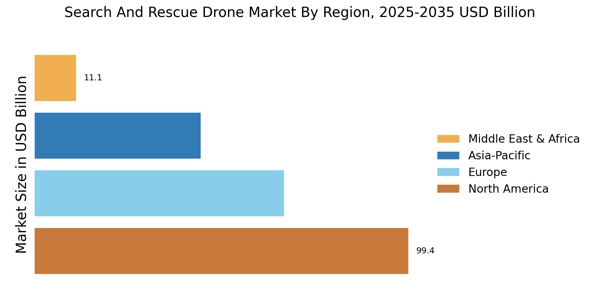
North America is the largest market for search and rescue drones, holding approximately 45% of the global market share. The region's growth is driven by increasing investments in public safety, advancements in drone technology, and supportive regulatory frameworks. The demand for drones in emergency response and disaster management is rising, fueled by the need for efficient and effective search operations. The United States is the primary player in this market, with significant contributions from Canada. Key players such as Lockheed Martin, Northrop Grumman, and AeroVironment are leading the competitive landscape, focusing on innovative solutions tailored for search and rescue missions. The presence of established companies and ongoing collaborations with government agencies further enhance market growth.

Europe : Emerging Market with Regulations

Europe is witnessing a growing demand for search and rescue drones, accounting for approximately 30% of the global market share. The region's growth is propelled by stringent safety regulations and increasing government initiatives aimed at enhancing public safety. Countries like Germany and France are at the forefront, with investments in drone technology for emergency services and disaster response. Germany leads the European market, followed closely by France and the UK. The competitive landscape features key players such as Parrot and Quantum Systems, which are innovating to meet regulatory requirements. The European Union's commitment to integrating drones into airspace management is a significant catalyst for market expansion, fostering collaboration among stakeholders.

Asia-Pacific : Rapid Growth and Adoption

Asia-Pacific is rapidly emerging as a significant market for search and rescue drones, holding about 20% of the global market share. The region's growth is driven by increasing natural disasters, urbanization, and the need for advanced technology in emergency response. Countries like Japan and Australia are leading the way, with government support for drone adoption in search and rescue operations. Japan is the largest market in the region, with Australia following closely. The competitive landscape includes key players like DJI and senseFly, which are focusing on developing user-friendly and efficient drones for rescue missions. The increasing collaboration between governments and private sectors is expected to further enhance market growth in this region.

Middle East and Africa : Untapped Potential and Growth

The Middle East and Africa region is witnessing a gradual increase in the adoption of search and rescue drones, accounting for approximately 5% of the global market share. The growth is driven by rising awareness of drone capabilities in emergency services and government initiatives to enhance disaster management. Countries like the UAE and South Africa are leading the charge, with investments in drone technology for public safety. The UAE is the largest market in this region, with South Africa also showing significant potential. The competitive landscape is still developing, with emerging players and collaborations between local governments and international companies. As regulatory frameworks evolve, the market is expected to expand, tapping into the region's potential for advanced drone applications.

Search And Rescue Drone Market Regional Image

Key Players and Competitive Insights

Major players in the search and rescue drone market are constantly innovating and developing new products to gain a competitive edge. Leading Search And Rescue Drone Market players are investing heavily in research and development to create drones with improved capabilities and features. The Search And Rescue Drone Market development is being driven by the increasing demand for drones for various applications, such as search and rescue operations, surveillance, and mapping.

The competitive landscape of the Search And Rescue Drone Market is expected to remain competitive in the coming years, with major players focusing on product innovation, strategic partnerships, and acquisitions to expand their market share.DJI, a leading player in the Search And Rescue Drone Market, offers a wide range of drones for various applications, including search and rescue operations. The company's drones are known for their reliability, durability, and ease of use. DJI has a strong presence and a large customer base, which gives it a competitive advantage in the market.

Another major player in the Search And Rescue Drone Market is Autel Robotics. The company offers a range of drones for both commercial and consumer use. Autel Robotics' drones are known for their high-quality cameras, long flight times, and advanced features. The company has a growing presence in the market and is expected to be a major competitor in the coming years.

Key Companies in the Search And Rescue Drone Market market include

Industry Developments

The search and rescue drone market is projected to reach USD 450.0 billion by 2032, exhibiting a CAGR of 10.7% during the forecast period (2024-2032). The rising adoption of drones for search and rescue operations in disaster-prone areas and the growing demand for real-time situational awareness during emergencies are major factors driving the market growth. Technological advancements, such as the integration of artificial intelligence (AI) and computer vision, are enhancing drone capabilities and increasing their effectiveness in search and rescue missions. Key players in the market include DJI, Parrot, Autel Robotics, and Skydio.

Recent developments include the launch of DJI's Matrice 300 RTK drone, designed specifically for public safety applications, and the collaboration between Autel Robotics and the National Oceanic and Atmospheric Administration (NOAA) to develop drones for marine search and rescue operations.

Future Outlook

Search And Rescue Drone Market Future Outlook

The Search And Rescue Drone Market is poised for growth at 10.72% CAGR from 2024 to 2035, driven by technological advancements, increasing demand for emergency response, and enhanced operational efficiency.

New opportunities lie in:

  • Integration of AI for real-time decision-making in rescue operations.
  • Development of specialized drones for maritime search and rescue.
  • Partnerships with government agencies for disaster response initiatives.

By 2035, the market is expected to be robust, driven by innovation and strategic collaborations.

Market Segmentation

Search And Rescue Drone Market Type Outlook

  • Fixed-Wing Drones
  • Multi-Rotor Drones
  • Hybrid Drones

Search And Rescue Drone Market Application Outlook

  • Search and Rescue
  • Disaster Response
  • Environmental Monitoring
  • Surveillance

Search And Rescue Drone Market Autonomy Level Outlook

  • Manual Control
  • Semi-Autonomous
  • Fully Autonomous

Search And Rescue Drone Market Flight Endurance Outlook

  • Less than 30 minutes
  • 30 minutes to 1 hour
  • 1 hour to 3 hours
  • More than 3 hours

Search And Rescue Drone Market Payload Capability Outlook

  • Small Payload (up to 2 kg)
  • Medium Payload (2-10 kg)
  • Large Payload (10 kg and above)

Report Scope

MARKET SIZE 2024220.96(USD Billion)
MARKET SIZE 2025244.64(USD Billion)
MARKET SIZE 2035677.34(USD Billion)
COMPOUND ANNUAL GROWTH RATE (CAGR)10.72% (2024 - 2035)
REPORT COVERAGERevenue Forecast, Competitive Landscape, Growth Factors, and Trends
BASE YEAR2024
Market Forecast Period2025 - 2035
Historical Data2019 - 2024
Market Forecast UnitsUSD Billion
Key Companies ProfiledMarket analysis in progress
Segments CoveredMarket segmentation analysis in progress
Key Market OpportunitiesIntegration of advanced artificial intelligence enhances operational efficiency in the Search And Rescue Drone Market.
Key Market DynamicsTechnological advancements and regulatory changes drive innovation and adoption in the Search and Rescue Drone Market.
Countries CoveredNorth America, Europe, APAC, South America, MEA

Leave a Comment

FAQs

What is the current valuation of the Search and Rescue Drone Market?

The market valuation reached 220.96 USD Billion in 2024.

What is the projected market size for the Search and Rescue Drone Market by 2035?

The market is expected to grow to 677.34 USD Billion by 2035.

What is the expected CAGR for the Search and Rescue Drone Market during the forecast period 2025 - 2035?

The market is projected to experience a CAGR of 10.72% from 2025 to 2035.

Which companies are considered key players in the Search and Rescue Drone Market?

Key players include DJI, Parrot, Lockheed Martin, Northrop Grumman, AeroVironment, FLIR Systems, senseFly, Skyfish, and Quantum Systems.

What are the different types of drones in the Search and Rescue Drone Market?

The market segments include Fixed-Wing Drones, Multi-Rotor Drones, and Hybrid Drones, with valuations of 66.29, 88.38, and 66.29 USD Billion respectively.

How does payload capability affect the Search and Rescue Drone Market?

Payload capability is categorized into Small, Medium, and Large Payloads, with market valuations of 22.1, 66.29, and 132.57 USD Billion respectively.

What applications are driving growth in the Search and Rescue Drone Market?

Key applications include Search and Rescue, Disaster Response, Environmental Monitoring, and Surveillance, with valuations of 40.0, 50.0, 30.0, and 100.96 USD Billion respectively.

What autonomy levels are available in the Search and Rescue Drone Market?

The market features Manual Control, Semi-Autonomous, and Fully Autonomous drones, with valuations of 40.0, 80.96, and 100.0 USD Billion respectively.

How does flight endurance impact the Search and Rescue Drone Market?

Flight endurance is categorized into various ranges, with the segment for more than 3 hours valued at 99.52 USD Billion.

What trends are expected to shape the Search and Rescue Drone Market in the coming years?

The market is likely to see advancements in technology and increased demand for autonomous drones, contributing to its growth during the forecast period.

Download Free Sample

Kindly complete the form below to receive a free sample of this Report

Compare Licence

×
Features License Type
Single User Multiuser License Enterprise User
Price $4,950 $5,950 $7,250
Maximum User Access Limit 1 User Upto 10 Users Unrestricted Access Throughout the Organization
Free Customization
Direct Access to Analyst
Deliverable Format
Platform Access
Discount on Next Purchase 10% 15% 15%
Printable Versions